
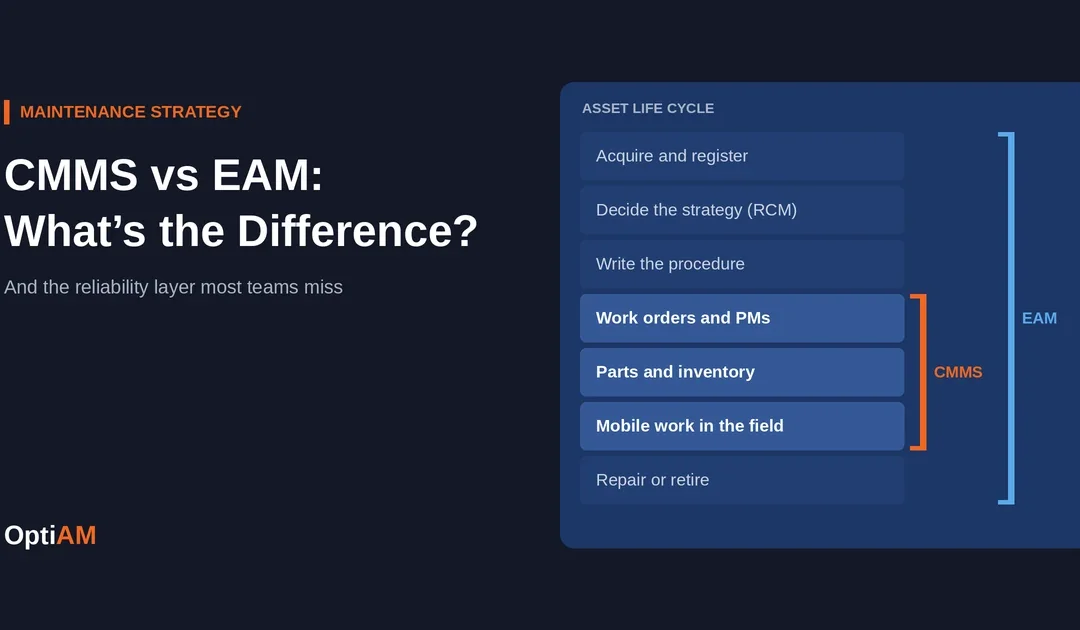
CMMS vs EAM comes down to scope. A CMMS runs day-to-day maintenance: work orders, preventive maintenance, parts and history. An EAM does all of that and also manages the asset across its whole life, from the day you buy it, through the decisions about how to maintain it, to the day you retire it.
That is the textbook answer, and every vendor page will give it to you. The more useful question is which problem you are actually trying to solve. If your pain is missed PMs and work orders on clipboards, you need a CMMS and you need it soon. If your pain is that nobody can say what an asset really costs, whether its PM plan makes sense, or when to replace it, you have an asset management problem, and a work order tool will not fix it.
This guide covers both, where the line between them has blurred, the layer both usually leave out, and how to decide what your plant or fleet needs.
What is a CMMS?
A CMMS (computerized maintenance management system) is software that plans, tracks and records maintenance work. It answers one question well: what work needs to be done, by whom, and when?
A typical CMMS covers:
- Work orders: requests, scheduling, assignment, sign-off and close-out
- Preventive maintenance: PMs generated by calendar, runtime hours, miles or meter readings
- Asset records: what you have, where it is, and what has been done to it
- Parts and inventory: stock levels, reorder points, parts used per job
- Mobile access: techs see and close work at the machine instead of at a desk
- Reports: PM compliance, backlog, downtime, labor hours
The CMMS is where the maintenance department lives. The people using it every day are techs, planners, schedulers and maintenance supervisors. See what OptiAM covers as a CMMS →
What is an EAM?
EAM (enterprise asset management) is software for managing physical assets across their entire life cycle, to get the most value out of them at the lowest total cost and risk. It answers a bigger question: what is this asset worth to the operation, and are we managing it the right way?
That lines up with how ISO 55000, the international asset management standard, frames the discipline: the coordinated activity an organization uses to realize value from its assets. Maintenance is a big piece of that, but it is not the whole thing.
On top of everything a CMMS does, an EAM usually adds:
- Acquisition and commissioning: the asset record starts before the first work order, with cost, warranty, contract and installed components
- Maintenance strategy: deciding what maintenance each asset should get, based on how it fails and what that failure costs
- Life cycle cost: labor, parts, downtime and contract cost rolled up per asset, per site and per class
- Multi-site and hierarchy: systems, subsystems and components across plants, yards or regions
- Compliance and audit trail: who changed what, when, and why, with the documentation attached
- Replace or repair decisions: the history you need to know when an asset has become more expensive to keep than to retire
EAM users include the maintenance team plus reliability engineers, asset managers, operations leaders and finance. See OptiAM for enterprise asset management →
CMMS vs EAM: side by side
| CMMS | EAM | |
|---|---|---|
| Core question | What work needs to happen, and did it get done? | What should we do with this asset over its life, and what is it costing us? |
| Scope | Maintenance execution | Full life cycle: acquire, maintain, analyze, retire |
| Main users | Techs, planners, maintenance supervisors | Maintenance plus reliability, operations, asset managers, finance |
| PM plans | Schedules and tracks the PMs you give it | Should help decide which PMs are worth doing at all |
| Cost view | Labor and parts per work order | Total cost of ownership per asset and asset class |
| Sites | Often one site or a few | Built for many sites and deep asset hierarchies |
| Typical rollout | Days to weeks | Traditionally many months, with consultants |
| Typical buyer | Small and mid-size maintenance teams | Larger or asset-intensive operations |
Where the line has blurred
Ten years ago the split was clean. CMMS was affordable software for the maintenance shop. EAM was a big-ticket enterprise system that took a year and a consulting firm to install.
That is no longer true. Cloud CMMS products have added multi-site support, asset hierarchies and cost reporting. Some EAM vendors have released lighter, faster versions. Plenty of software is sold under both labels, and the label on the box tells you less than it used to.
So do not buy the acronym. Buy the capabilities you need now, and make sure the system can grow into the ones you will need in two years without a second migration.
The layer most CMMS and EAM systems skip: deciding what maintenance to do
Here is what almost every CMMS vs EAM comparison leaves out. Both kinds of software are good at scheduling PMs and recording that they got done. Very few help you decide whether those PMs should exist in the first place.
Most PM programs were copied, not analyzed. They started as the OEM manual, then picked up whatever the last planner added after the last bad failure. Nobody went back and asked whether the 30-day inspection on that conveyor actually prevents anything, or whether the quarterly teardown on that pump is causing more problems than it catches.
That matters because a lot of equipment does not wear out on a neat schedule. The classic airline study behind reliability-centered maintenance (RCM), published by Nowlan and Heap in 1978, found that only a small share of the components they studied showed a clear wear-out age. Most failed in patterns that a fixed-interval overhaul could not prevent. Those exact percentages came from 1960s aircraft parts and should not be pasted onto your plant, but the lesson holds: a time-based PM on a component that fails randomly spends labor and parts without reducing failures, and every intrusive task is a chance to introduce a new fault.
RCM is the structured way to fix this. Defined in the SAE JA1011 standard, it works through seven questions for each asset:
- What does the asset have to do, and to what standard?
- How can it fail to do that?
- What causes each failure?
- What happens when it fails?
- How much does each failure matter?
- What task, if any, will predict or prevent it?
- What do you do if no task is worth doing?
The answers become a maintenance plan you can defend line by line. Some PMs get dropped. Some change from a calendar interval to a condition check or a meter reading. Some critical failure modes that had no PM at all finally get one.
Why does this belong in a software decision? Because if the analysis lives in a consultant’s spreadsheet and the PMs live in your CMMS, the two drift apart within a year. Someone changes a task, nobody updates the analysis, and you are back to a copied plan. The strategy and the work orders have to live in the same system.
What this looks like on a fleet: a truck fleet that replaces a component every 25,000 miles because the manual says so, even though the unit history shows it fails at random, is paying for parts and shop hours that do not buy uptime. Switch that task to an inspection tied to the meter reading, and keep the time-based change only where the history shows real wear-out. That kind of change comes from analysis, not from a better work order screen.
Where does your maintenance program actually stand?
The Maintenance Maturity Scorecard rates your team from reactive to reliability-driven and shows which gap to close first. It helps you tell whether you need a CMMS, an EAM, or just better use of what you have.
Related: If the push is to use your ERP’s maintenance module instead, read CMMS vs ERP for facilities before that decision gets made.
CMMS or EAM: which one do you need?
Skip the labels and match the tool to the problem you have today.
A CMMS is probably enough if:
- You run one site, or a few sites with similar equipment
- Your biggest pain is missed PMs, lost work orders and no history
- Maintenance is the only department that needs to be in the system
- You do not have anyone who will act on life cycle cost data yet
You are into EAM territory if:
- You manage assets across multiple plants, yards or regions and need one view
- Leadership is asking what each asset or asset class really costs
- You have to explain to an auditor, customer or regulator why each PM exists
- You are making repair or replace calls on expensive equipment without good data
- Your PM plan came from OEM manuals and has never been reviewed
- Failures on a few critical assets drive most of your downtime
A spreadsheet is still fine if:
You have one site, a handful of assets and one person who owns the file. That is a real answer, not a sales trick. When PMs start depending on someone remembering, or history requests take days, you have outgrown it. We wrote a full guide on the seven signs your team has outgrown Excel.
Questions to ask any CMMS or EAM vendor
- Can PMs trigger on hours, miles and meter readings, not just calendar dates?
- Does the mobile app work fully offline and sync later without losing anything?
- Can the system hold the reasoning behind each PM, or only the schedule?
- How long does a typical rollout take, and who loads our asset data?
- What does pricing scale on: users, assets or sites?
- If we start small, can we grow into full asset management without migrating again?
- Who built it? People who have run maintenance and reliability programs, or only software developers?
That last question matters more than it looks. It decides whether the software fits how maintenance actually works, or whether your team ends up working around it.
Fleets need a CMMS and an EAM at the same time
Fleet maintenance lives on meters: miles, engine hours and fuel. Units are spread across yards and job sites, and every unit is its own cost center with a replace-or-repair decision coming. That is why fleets tend to outgrow a basic CMMS first.
Why OptiAM: built by reliability engineers, RCM analysts and maintainers
OptiAM is both a CMMS and an EAM, depending on how you use it. Start with work orders and PMs on day one. Add maintenance strategy, RCM analysis and multi-site asset management when you are ready, in the same system, without a second implementation.
The bigger difference is who built it. OptiAM comes from Andromeda Systems Incorporated, the reliability and supportability engineering team that has supported DoW assets since 2005. It was not designed by a software team guessing at how maintenance works. It was developed and vetted by the RCM analysts, reliability engineers and maintainers who do this work for a living.
- We helped write the standard. Our staff helped write SAE JA1011 and JA1012, the standards that define what a real RCM analysis has to include.
- We have done the work. Hundreds of RCM projects on vehicle fleets, plant and mining equipment, facilities, data centers and hospitals.
- Built for the person at the machine. Procedures, manuals, training video and parts come attached to the work order, and the mobile app keeps working with no signal, because that is where maintainers actually are.
You do not need to run jets to benefit from that. The discipline that keeps high-consequence equipment available works the same way on a crusher, a compressor, a packaging line or a truck.
Cradle to grave, in one system
Most operations stitch the asset life cycle together from a CMMS, a few spreadsheets, a shared drive full of manuals and a consultant’s RCM report. OptiAM is built so you can run it cradle to grave, with the right data, in one place:
| Life cycle stage | What happens | OptiAM module |
|---|---|---|
| Acquire and register | Serial, model, location, custodian, warranty, cost, installed components | Asset Manager |
| Decide the strategy | Failure modes, criticality, and which tasks are worth doing | RCM Analyzer and Maintenance Optimizer |
| Write the procedure | Step-by-step tasks, maintenance packages, SOPs | Task Developer |
| Do the work | Work orders, sign-offs, routing across work centers | Work Order Manager |
| Work in the field | Offline mobile work orders, checklists and meter readings | OptiAM GO |
| Keep parts on hand | Stock, reorder points, parts per job | Inventory Manager |
| Keep the knowledge | Manuals, drawings and training video tied to each asset | Live Library |
| See the whole picture | Live status and backlog across sites | Management Center |
| Repair or retire | Full history, usage and cost to support the call | Asset Manager |
Because the analysis and the work orders live in the same database, the strategy does not drift away from what the techs are actually doing. Change a task and you can see the failure mode it was built to address. When an auditor asks why a PM exists, the answer is one click away.
If your team does not have time to run the analysis, Andromeda Systems Incorporated also offers RCM services: we can run the analysis with your people, facilitate your first sessions, or train your team to do it on their own.
The practical details
- Pricing starts at $500 a month and scales mainly with the number of assets and facilities. Adding people does not change the price. Get a quote for your asset count on a quick demo call.
- Rollout takes weeks, not months. Send us your asset list and we help load it and train your team.
- Deployment as SaaS or on-premises.
- Mobile that works offline, on cellular or on Wi-Fi, and syncs when the signal comes back.
When OptiAM is not the right fit
Being straight about this saves everyone time. OptiAM is not an ERP, so depreciation and general ledger accounting stay in your finance system. If you are a small shop that only needs a simple request and work order app for a few techs, a lighter tool may be all you need for now. OptiAM earns its keep when uptime matters, the asset base is growing, and you want the maintenance plan built on analysis instead of habit.
The short version
- A CMMS runs maintenance: work orders, PMs, parts and history.
- An EAM manages the asset for its whole life: acquisition, strategy, cost, compliance and retirement.
- The line has blurred. Buy the capabilities you need and the room to grow, not the acronym.
- Both usually skip strategy. Scheduling PMs is not the same as knowing which PMs are worth doing. That is what RCM answers.
- OptiAM is both, built by the RCM analysts, reliability engineers and maintainers who helped write the standard, and covers the asset cradle to grave in one system.
Find out what your maintenance program needs next
The Maintenance Maturity Scorecard shows whether you are running reactive, preventive or reliability-driven, and what to fix first. It takes about five minutes.
Take the Maturity Scorecard →Or talk to the OptiAM teamCall 904-402-8641
Common questions
What is the main difference between a CMMS and an EAM?
Scope. A CMMS manages maintenance work: work orders, preventive maintenance, parts and asset history. An EAM does all of that and manages the asset across its full life cycle, including acquisition, maintenance strategy, total cost of ownership, compliance and retirement.
Is a CMMS part of an EAM?
Usually, yes. Most EAM systems include full CMMS functions as their maintenance core. You can think of a CMMS as the maintenance execution layer and an EAM as that layer plus the strategy, cost and life cycle layers around it.
Is EAM software more expensive than a CMMS?
Traditionally, yes. Enterprise EAM platforms often come with long implementations and consulting costs. That gap has narrowed. Some platforms, including OptiAM, cover both CMMS and EAM needs with pricing that starts at $500 a month and scales with assets and facilities rather than users.
When should a company move from a CMMS to an EAM?
When the questions change from “did the work get done” to “is this the right work, and what is this asset really costing us.” Common triggers are multiple sites, pressure to show cost per asset, audit or compliance demands, repair or replace decisions on expensive equipment, and a PM plan that has never been reviewed.
Which is better for fleet maintenance, a CMMS or an EAM?
Most fleets need both at once. They need CMMS basics like meter-based PMs, work orders and offline mobile for techs in the yard, plus EAM functions like cost per unit, multi-location visibility and repair or replace decisions. Look for a system that covers both without a second implementation.
Where does reliability-centered maintenance fit in CMMS vs EAM?
RCM decides what maintenance each asset should get, based on how it fails and what each failure costs. A CMMS schedules the tasks, and an EAM should hold the strategy behind them. Keeping the RCM analysis and the work orders in the same system is what stops the maintenance plan from drifting.
Is OptiAM a CMMS or an EAM?
Both, depending on how you use it. Teams often start with work orders, PMs and offline mobile, then add RCM Analyzer, cost and downtime comparisons between strategies, and multi-site asset management in the same system. OptiAM is built by Andromeda Systems Incorporated, the reliability and supportability engineering team that has supported DoW assets since 2005.
Keep reading
CMMS vs ERP for FacilitiesWhy the one-system decision backfires, and how to make the case for a real CMMS.7 Signs Your Maintenance Team Has Outgrown ExcelHow to tell when the spreadsheet is costing you more than it saves.10 Reasons Your Company Needs a Work Order SystemThe signs you have outgrown sticky notes and email, and what to look for in a system.