
Enterprise Asset Management
Enterprise Asset Management Software for the Whole Life of the Asset
OptiAM is a web-based enterprise asset management system that carries an asset from the day you acquire it to the day you retire it. One database holds the equipment record, everything ever done to it, and the analysis that decides what its maintenance should be.
Reliability and supportability analysis included, not sold separately. Offline mobile in every deployment. Unlimited sites and assets, with rapid implementation in weeks, not months.
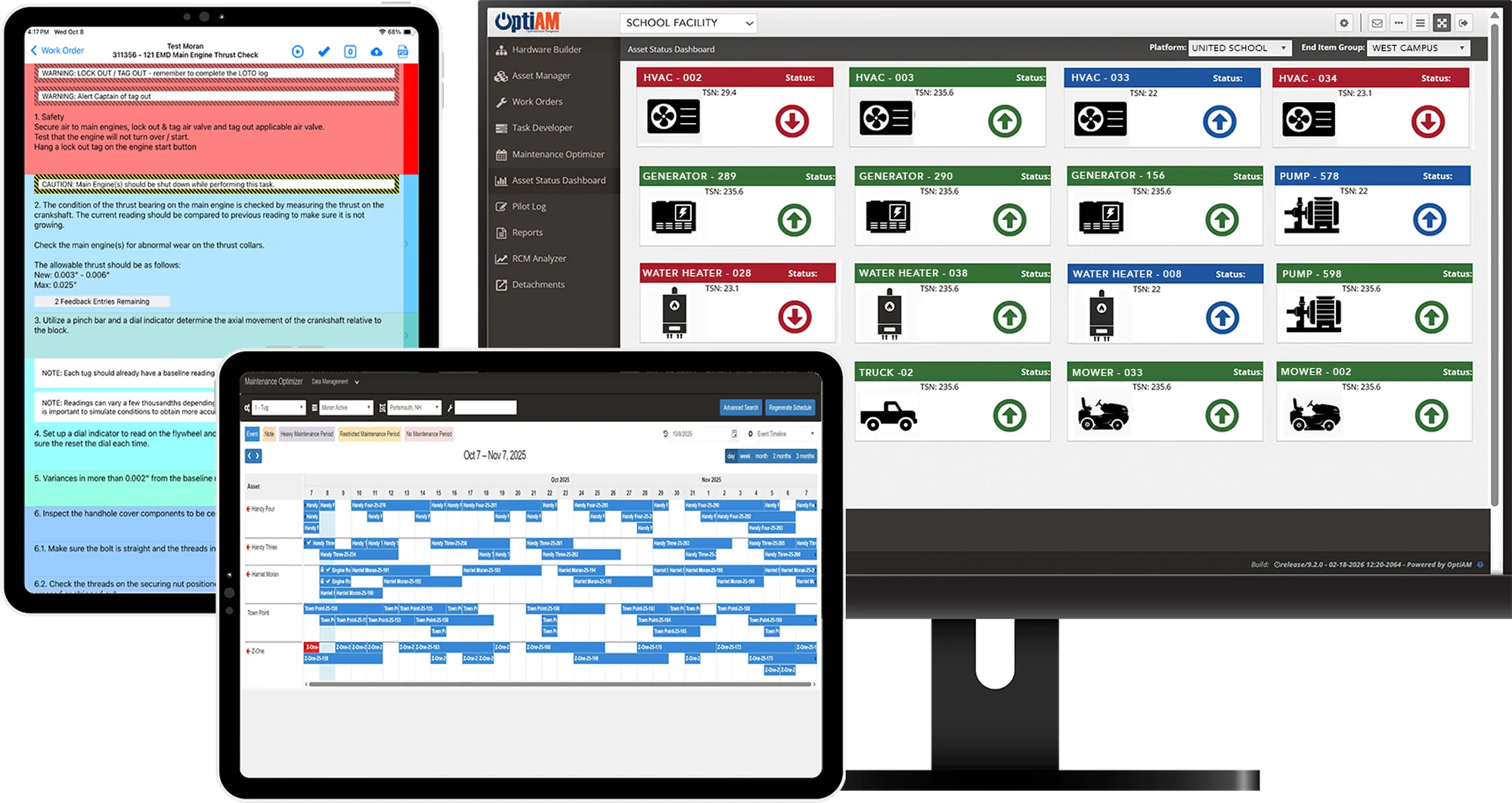
The OptiAM platform
What Enterprise Asset Management Actually Covers
Enterprise asset management is the discipline of managing a physical asset across its entire life rather than one maintenance event at a time. It begins when the asset is acquired and defined, continues through every hour it runs and every component ever installed on it, and ends with a defensible decision about when to overhaul it, replace it or let it go. Maintenance execution is one chapter of that story, not the whole of it.
Define it once, properly
Every asset gets one record carrying serial number, part number, manufacturer, model, location, custodian, status, service and warranty dates, cost and contract. Hardware Builder breaks it into physical and functional hierarchies as deep as you need, and defines which manufacturers and part numbers are acceptable at each node.
Run it on real usage
Usage readings, installed components and completed work accumulate against that record for as long as you own the asset. Maintenance is scheduled on that usage and on the environment the asset operates in, and every component change stays attached to the machine rather than to whoever remembers it.
Decide what happens next
Spare parts analysis and life-cycle cost analysis run against the history you have been collecting, which is what turns a pile of maintenance records into an overhaul, replace or retire decision you can defend in front of a finance director.
What We Do Differently
Most systems in this category grew out of a work order app and added asset management later. That order shows up in three places buyers notice during an evaluation, and it is where OptiAM is deliberately different.
Offline is standard, not a tier
OptiAM GO works offline or online in every deployment, on Apple, Android and Windows. It is not an upgrade, an add-on or a higher plan. Crews in a pump house, a basement or at the far end of a site keep working, and the app synchronizes when the device comes back into range.
Parts and purchasing are not secondary
Inventory Manager handles serialized assets and bulk stock on an enterprise and location-by-location basis, with combined stock levels at any level of the hierarchy, reorder points defined per location, and tools for purchase orders, receiving and adjustments. It was built alongside the asset registry, not bolted on after it.
The analysis comes with it
RCM, product support analysis, maintenance planning, spare parts analysis and life-cycle cost analysis are part of the platform. A system that only captures work can tell you what you did. It cannot tell you what you should be doing, and that is the question an asset manager is actually paid to answer.
One Record That Outlives Everyone Who Touches It
Asset knowledge walks out the door. The mechanic who knew that pump leaves, the folder of manuals moves offices, and the spreadsheet that tracked overhauls belongs to somebody who changed jobs. An EAM exists so the asset keeps its own history regardless of who is standing next to it. In OptiAM that record carries the hierarchy it sits in, every component ever installed, every reading taken and every job performed, for as long as you own the machine.
Parts, Purchasing and the Stores Room
Inventory Manager runs stock on an enterprise and location-by-location basis at the same time. Serialized assets and non-serialized bulk stock both sit in it, combined levels roll up to any point in the location hierarchy, and reorder points are set per site so the main shop and the outlying yards each carry what they actually use.
Purchase orders, receiving and stock adjustments are part of the same module rather than a separate product. Because inventory works against Hardware Builder and the asset registry, a part is tied to the equipment it actually fits, which is what stops the wrong filter being ordered and the right one being bought twice.
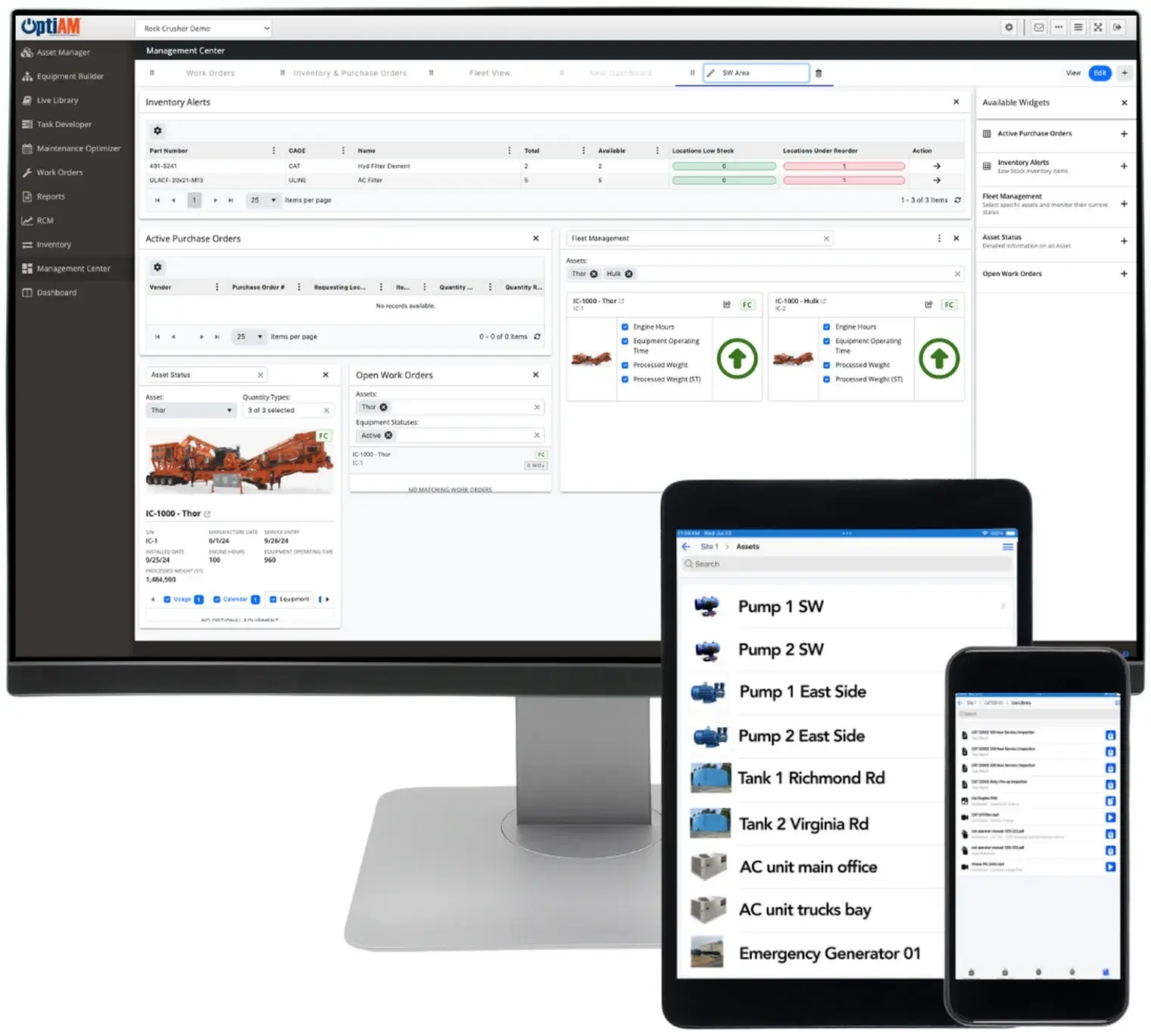
At a Glance
What an EAM Has to Hold
Work Order Manager
The equipment registry. One record per asset with hierarchy, custodian, status, usage readings, installed components and the complete history behind it.
Maintenance Optimizer
The hardware breakdown. Physical and functional trees as deep as you need, with the acceptable manufacturers and part numbers defined at each node.
Inventory Manager
Stock and purchasing. Serialized and bulk stock by location, combined levels at any level of the hierarchy, reorder points per site, purchase orders and receiving.
Asset Manager
The maintenance program. Scheduling driven by each asset’s usage and environment, with packages, automated triggers and contract and warranty dates carried alongside.
Task Developer
Procedures and documentation. SOPs and emergency procedures with tracked revisions, plus manuals and drawings tied to the asset and searchable in the field.
Live Library
The analysis layer. RCM, product support analysis, maintenance planning, spare parts analysis and life-cycle cost analysis against the history you have collected.
See It Running on Your Own Assets
Book a 30-minute demo. We will look at how your assets are structured today, what history you already have on them, and what it would take to run the whole life of that equipment in one system.
A short call so we understand your operation
A walkthrough on equipment like yours
A rollout plan that has you live in weeks
Common Questions
What is enterprise asset management software?
EAM software manages a physical asset across its whole life rather than one maintenance event at a time. It holds the equipment record, accumulates usage, component changes and completed work against it, and carries the analysis that decides what maintenance the asset should have and when it stops being worth keeping.
What is the difference between EAM and a CMMS?
A CMMS runs the maintenance. Work orders, preventive schedules, parts and procedures. An EAM does that and adds the two ends a CMMS leaves out: structuring the asset properly at the start, and the analysis that decides when to overhaul, replace or retire it. OptiAM is both. Execution is covered on the CMMS software page.
How deep can the asset hierarchy go?
As deep as the asset warrants. Hardware Builder defines physical and functional hierarchies and lets you break equipment down in as much or as little detail as you want. At each node you can define the manufacturers and part numbered components that are acceptable for installation, which is what keeps the registry accurate as parts get swapped over the years.
Does the analysis come with it or cost extra?
It is part of the platform. RCM analysis against SAE JA1011, product support analysis, maintenance planning, spare parts analysis and life-cycle cost analysis are built in rather than sold as a separate tier or a services engagement. That analysis is the reason the maintenance program exists in the first place, so gating it behind an upgrade never made sense to us.
How many sites and assets can OptiAM handle?
There is no limit built into the platform. The web-based architecture supports an unlimited number of locations and assets, and the role-based security model is flexible enough to match how your organization is actually structured, so one site and fifty sites run on the same hierarchy.
Is offline mobile included, or is it an upgrade?
Included, in every deployment. OptiAM GO works offline or online over cellular or Wi-Fi, on Apple, Android and Windows devices. It is not a premium plan, an add-on or a separate licence. Crews working in a pump house, a basement or at the far end of a site keep working, and the app synchronizes when the device comes back into range.
How fast can we get OptiAM running?
Weeks, not months. You bring the asset list, we handle the build and walk your team through it. If your data lives in spreadsheets, binders, or another system, that is normal. Getting it into shape is part of getting started, not something you have to finish first.
What does OptiAM cost?
Pricing starts at $500 a month and scales with what you are managing, mainly the number of assets and the number of facilities. Adding people does not change the price. The savings calculator will give you a rough figure.
Which standards does OptiAM align to?
OptiAM is built on a standards based architecture and supports compliance with SAE JA1011, SAE GEIA-STD-0007, SAE TA-STD-0017, ISO 55000 and the ASD S-Series IPS specifications. Andromeda Systems, which builds OptiAM, is an ISO 9001:2015 company.
Can parts and purchasing really run in the same system?
Yes, and they were built alongside the asset registry rather than added later. Inventory Manager handles serialized assets and bulk stock on an enterprise and location-by-location basis, rolls combined stock levels up to any level of the location hierarchy, sets reorder points per location, and handles purchase orders, receiving and adjustments. Because it works against Hardware Builder, a part is associated with the equipment it actually fits.
Is OptiAM cloud-based or installed?
Either. OptiAM runs as SaaS or installed on your own infrastructure, so it works for operations with strict IT or security requirements as well as for teams that would rather not run another server.
How is OptiAM different from the rest of the category?
Most systems in this category started as a work order app and added asset management afterwards, so execution is strong and the decision layer is thin. OptiAM was built from the analysis end first. In practice that means offline mobile ships in every deployment, parts and purchasing are first-class, and the analysis that sets the maintenance program comes with the platform.
Start With Your Industry
What you are managing changes what the system has to hold. A quarry, a treatment plant and a school district run different assets under different rules. If you want to see it built for your operation, start with your industry: manufacturing and plants, food and beverage, energy and utilities, mining and aggregates, facilities, government and public works, schools and campuses, farming and agriculture, or landscaping.
See OptiAM on Your Own Equipment
Tell us what you own and how it is organised today, and we will set up a 30-minute walkthrough.
"*" indicates required fields

Contact us
Connect with us
Capabilities
Enterprise Asset Management (EAM)
Computerized Maintenance Management System (CMMS)
Preventive Maintenance
Analytics & Reporting