
CMMS and EAM software for food and beverage manufacturing
CMMS Software Built for Food and Beverage Plants
When a filler jams mid-run or the blast freezer goes down, the cost is not the repair. It is the product on the floor, the crew standing around waiting on a part, and the auditor asking for records you cannot find. OptiAM runs your processing lines, your packaging hall, your utilities room, and your fleet in one place, with preventive maintenance, work orders, spare parts, sanitation and safety procedures, and audit-ready records built in.
Proven reliability methods, without the enterprise price tag. Runs on any device, online or off. Up and running in weeks, not months.
See OptiAM on Your Line
Tell us about your plant and we will set up a 30-minute walkthrough.
"*" indicates required fields
Reactive Maintenance is the Most Expensive Way to Run a Food Plant
Most food and beverage plants still fix equipment after it fails. That is the costliest way to work, because on a connected line a single failure rarely stays contained to one machine. When a filler, a case packer, or the ammonia compressor goes down, everything upstream and downstream stops with it, and whatever was in the line goes with it.
One failure stops the whole line, not one machine
A jammed filler, a failed seamer, or a down compressor backs up everything behind it, so the cost shows up as scrapped product, missed shipments, and a crew standing around, not just the part.
A stopped line can cost you the batch
Product sitting past its window is not a repair problem, it is scrap. Add the sanitation reset and a shift you cannot get back.
Paper records don't hold up in an audit
Handwritten PM sheets and clipboard checklists are easy to lose and slow to produce when an SQF or BRC auditor, a customer, or an inspector asks.
OptiAM® EAM Software
One System to Run Maintenance Across Every Line, Plant, and Cold Room
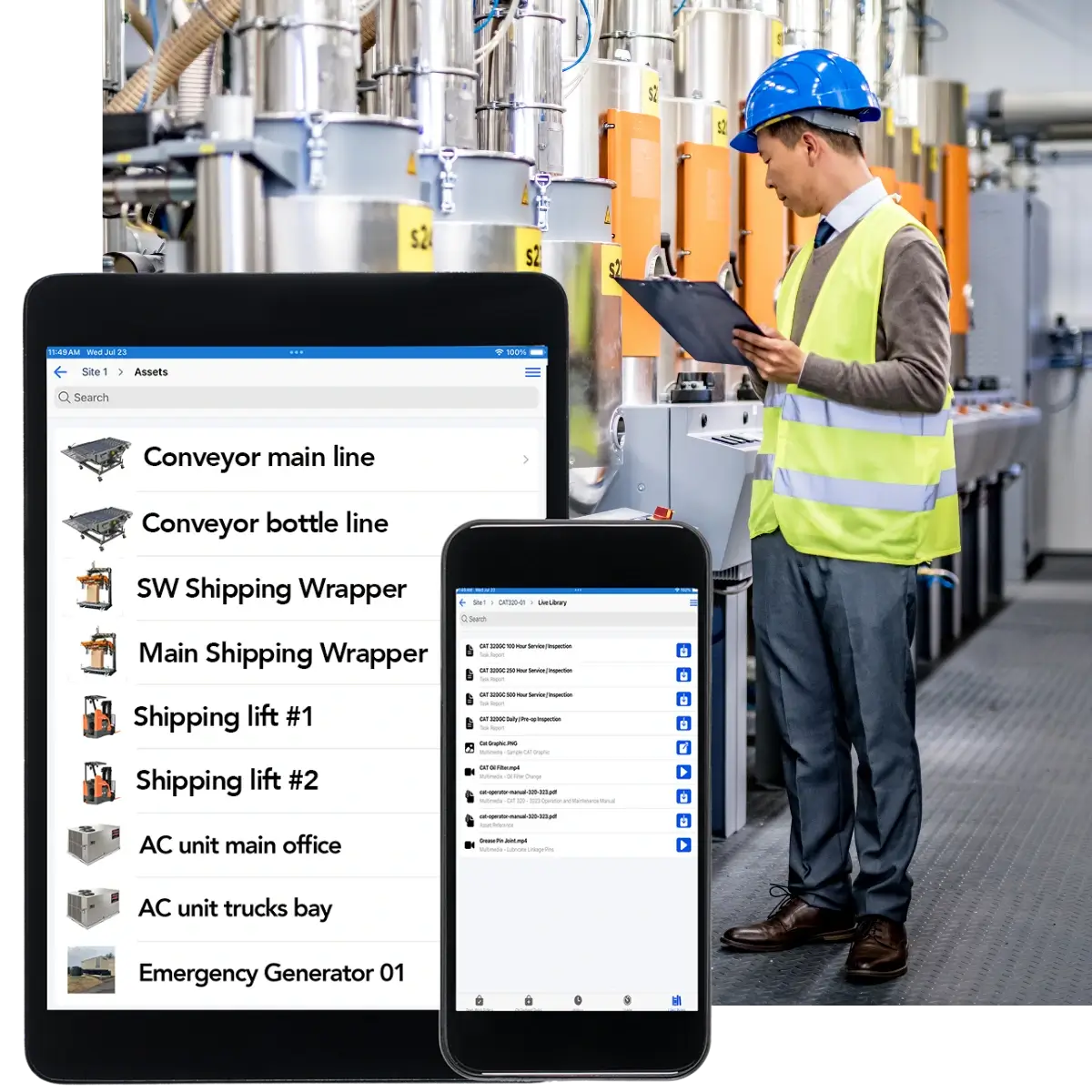
OptiAM is enterprise asset management (EAM) and CMMS software built on Reliability Centered Maintenance. It schedules maintenance by how your equipment actually gets used, tracks every asset and spare part across every line, plant, warehouse, and truck, and puts procedures and work orders on a phone that works with no signal. The methods come from aviation, where a missed failure is never an option. Food and beverage plants use it to move from firefighting to planned, optimized maintenance.
Food Safety & Compliance
Sanitation, Lockout/Tagout, and Food Safety Records That Hold Up
Lockout/tagout steps, PPE requirements, allergen changeover checks, and CIP and sanitation sign-offs live inside the work order instead of a binder in the maintenance office. Revisions are controlled, so nobody works off an outdated sheet, and every completed job leaves a time-stamped record you can produce on demand. Techs follow the same steps on a filler, in a cold room, or in the utilities room, because OptiAM GO works fully offline on Apple, Android, and Windows.
- Lockout/tagout, PPE, allergen changeover, and CIP steps built into the work order, with controlled revisions
- Multi-level sign-offs, so a job cannot close until QA or the right supervisor approves it
- Step-by-step instructions and video at the point of work, so every shift does it the same way
- Time-stamped completion records for any asset, searchable on demand

Audit Readiness
Maintenance Evidence Ready for Any SQF, BRC, or Customer Audit
Auditors and customers ask the same three questions: is the equipment maintained, is there a defined schedule, and can you prove it. OptiAM answers all three from one system. Every finding a tech logs becomes a work order, tracked all the way to close-out, and every asset carries a complete maintenance history you can pull up in front of an auditor.
- Digital inspection, PM, and sanitation checklists with time stamps and sign-off
- Finding to work order to close-out, documented end to end
- Searchable maintenance history for any asset, on demand
- Standard operating procedures, SSOPs, and emergency procedures with version control
Built for Every Asset in the Plant, From the Process Floor to the Fleet
Manage the whole operation on one platform, with unlimited sites and assets. Processing, packaging, utilities, and cold chain all sit in the same system, on the same hierarchy, with the same maintenance history behind them.
Processing and Prep
Mixers, blenders, kettles, homogenizers, pasteurizers, HTST and CIP skids, extruders, ovens, fryers, slicers, and metal detectors
Packaging and Filling Lines
Fillers, cappers, seamers, labelers, depalletizers, case packers, palletizers, shrink wrappers, conveyors, checkweighers, and X-ray inspection
Utilities, Cold Chain, and Fleet
Ammonia and glycol refrigeration, blast freezers, boilers, air compressors, chillers, water treatment and wastewater, plus forklifts, yard trucks, and refrigerated trailers
Capabilities
From Work Orders to Spare Parts, in One Place
Maintenance Optimizer
Usage-Based Preventive Maintenance. Schedule on real runtime, cycle counts, case counts, and condition data instead of the calendar, so a filler running three shifts and a seasonal line each get serviced when they need it. Wear rates change with product, speed, and washdown, and OptiAM schedules to match.
Work Order Manager
Work Orders Across Every Line and Shift. Plan, assign, and sign off maintenance with parent and subordinate work orders that route across trades and shifts, so a changeover, a sanitation window, or a full line rebuild stays coordinated from one record.
Inventory Manager
Spare Parts Across Every Plant. Track serialized and bulk stock, set reorder points per storeroom, and move surplus gearboxes, drives, seals, or belting between plants instead of buying them twice.
Asset Manager
One Asset Record, Found Fast. QR code and RFID tags pull up serial number, warranty, vendor, and full service history at the machine, and Hardware Builder breakdowns show exactly what goes where, so techs stop hunting for records or ordering the wrong part.
Management Center
A Live View of Every Line. One dashboard shows what is down, what is due, and where the backlog is across every line, plant, and cold room, so you can move people and parts to the right place first.
Task Developer
Procedures Your Techs Actually Follow. Build checklists, SSOPs, and emergency procedures with controlled revisions, then deliver them, along with every manual and spec sheet in Live Library, straight to the phone through OptiAM GO.
Trusted Where Uptime is the Business
“The OptiAM team has been extremely helpful in explaining the software and identifying features that are applicable to our situation. The software is flexible and the team is open to our feedback. They are constantly making improvements to the software.”
— Travis Martyn, LafargeHolcim
“In the past, we were only capable of updating maintenance plans annually, because the master document was kept locally and distributed as hard copies. Now, because of OptiAM, we can make changes to PM tasks within minutes, immediately accessible to all users around the country.”
— Moran Towing
Built on Reliability Centered Maintenance (SAE JA1011) and ISO 55000, from Andromeda Systems, an ISO 9001:2015 veteran-owned company that has supported some of the U.S. military’s most demanding fleets.
Why Food and Beverage Teams Pick OptiAM
Offline-first mobile that works in cold rooms, washdown areas, and utilities spaces
Built on RCM analytics, not just a work-order log, so maintenance improves over time
Processing, packaging, utilities, and the fleet on one platform, with no asset limits
Rapid implementation, with your team working in the system in weeks, not months
Run a Brewery? Start With HoptiAM Instead
HoptiAM is our brewery build of OptiAM. Same platform, same offline mobile app, but set up around brewhouse, cellar, and packaging assets with the terminology and PM schedules a brewery actually uses, so you are not renaming a generic CMMS to fit beer production. If your operation is a brewery, or a beverage plant with a brewing side, that is the faster starting point.
Your Buildings Count Too
Every plant has a building around it: HVAC and rooftop units, boilers, air compressors, fire systems, elevators and standby generators. OptiAM runs all of it on the same platform and the same hierarchy as your processing and packaging lines, so facilities work does not end up in a separate spreadsheet nobody looks at.
See What OptiAM Does for Your Plant
Book a 30-minute demo. We will look at your lines, your utilities, your sanitation schedule, and your audit requirements, and show you exactly how OptiAM handles them.
A short call so we understand your plant
A walkthrough on equipment like yours
A rollout plan that has you live in weeks
Common Questions
What is the best CMMS for a food and beverage plant?
The right one is the one your techs will actually use on the floor. In a food or beverage plant that usually means preventive maintenance driven by real runtime and case counts instead of a calendar, work orders that route across shifts and trades, spare parts tied to a storeroom, and procedures a tech can pull up at the machine in a washdown area with no signal. OptiAM does all of that in one system and adds Reliability Centered Maintenance analysis on top, so your PM program gets better over time instead of just recording what already broke.
Does OptiAM work offline in a cold room or washdown area?
Yes. OptiAM GO is a progressive web app that works fully offline on Apple, Android, and Windows devices. Techs complete work orders, run checklists, capture photos, scan parts, and pull up asset history in a freezer, a utilities room, or anywhere in the plant with no signal. Everything syncs automatically when the device is back in range.
How does OptiAM support sanitation, lockout/tagout, and food safety compliance?
Lockout/tagout steps, PPE requirements, allergen changeover checks, and CIP and sanitation sign-offs are built into the task package, so they travel with the work order to the technician’s device. Revisions are controlled, so nobody works off an outdated sheet, and work orders support multi-level sign-off so a job cannot close until QA or the right supervisor approves it. Every completed job leaves a time-stamped record you can produce for an OSHA inspection or a food safety audit.
Will OptiAM help with SQF, BRC, and FSSC 22000 audits?
Yes. Auditors want to see that equipment is maintained on a defined schedule, that the work actually happened, and that you can prove it. OptiAM holds the schedule, the completed work orders, the maintenance history for every asset, and the controlled procedures behind them. When an auditor asks for evidence on a specific filler, metal detector, or pasteurizer, you pull it up instead of digging through binders.
What equipment can OptiAM manage?
Anything with a maintenance requirement. Processing equipment like mixers, blenders, kettles, homogenizers, pasteurizers, CIP skids, ovens, fryers, and slicers. Packaging line assets like fillers, cappers, seamers, labelers, case packers, palletizers, conveyors, checkweighers, metal detectors, and X-ray units. Plant utilities like ammonia and glycol refrigeration, blast freezers, boilers, air compressors, chillers, and water and wastewater systems. Plus forklifts, yard trucks, and refrigerated trailers, and the tooling and calibrated test gear behind all of it.
Can OptiAM handle our forklifts and refrigerated fleet too?
Yes, and most plants we talk to are running that equipment in a separate system or a spreadsheet. OptiAM schedules forklift and trailer PM on engine hours or mileage the same way it schedules a filler on runtime, tracks parts out of the same storeroom, and keeps every service record, inspection, and repair on the vehicle’s own asset record. Forklifts, yard trucks, reefer trailers, and pallet jacks sit in the same hierarchy as the line.
How fast can we get OptiAM running?
Weeks, not months. You bring the asset list, we handle the build and walk your team through it. If your data lives in spreadsheets, binders, or another system, that is normal. Getting it into shape is part of getting started, not something you have to finish first.
Can OptiAM manage maintenance across multiple plants?
Yes. OptiAM handles unlimited sites and assets on one platform, with physical and functional hierarchies so every line, plant, and warehouse rolls up correctly. Inventory is tracked per storeroom with location-specific reorder points, and you can see combined stock at any level of the hierarchy, so you can move a surplus spare between plants instead of buying another.
Is OptiAM cloud-based or installed?
Either. OptiAM runs as SaaS or installed on your own infrastructure, so it works for plants with strict IT or corporate security requirements as well as for teams that would rather not run another server.
How is OptiAM different from a generic CMMS?
Most CMMS tools are work-order logs. They record what you did after you already decided to do it. OptiAM is built on Reliability Centered Maintenance and Supportability Analysis, so it looks at how your assets actually fail and tells you what to maintain, how often, and what it costs you to get it wrong. That is the difference between tracking maintenance and improving it.
Do you have something built for breweries?
Yes. HoptiAM is our brewery-specific build of OptiAM, set up around brewhouse, cellar, and packaging assets with the terminology and PM schedules a brewery actually uses. It is the same platform and the same offline mobile app, just configured for beer production out of the box. If you run a brewery or a beverage plant with a brewing side, start at hoptiam.com.

Contact us
Connect with us
Capabilities
Enterprise Asset Management (EAM)
Computerized Maintenance Management System (CMMS)
Preventive Maintenance
Analytics & Reporting