
RCM Analyzer
Reliability-Centered Maintenance Software That Shows Why Every PM Exists
RCM Analyzer walks your team step by step through figuring out which PMs actually prevent failures and which ones just eat labor and parts. Start with one critical asset, not a massive program. Every decision stays on record, so you can explain each PM to an auditor, a new manager or yourself a year from now.
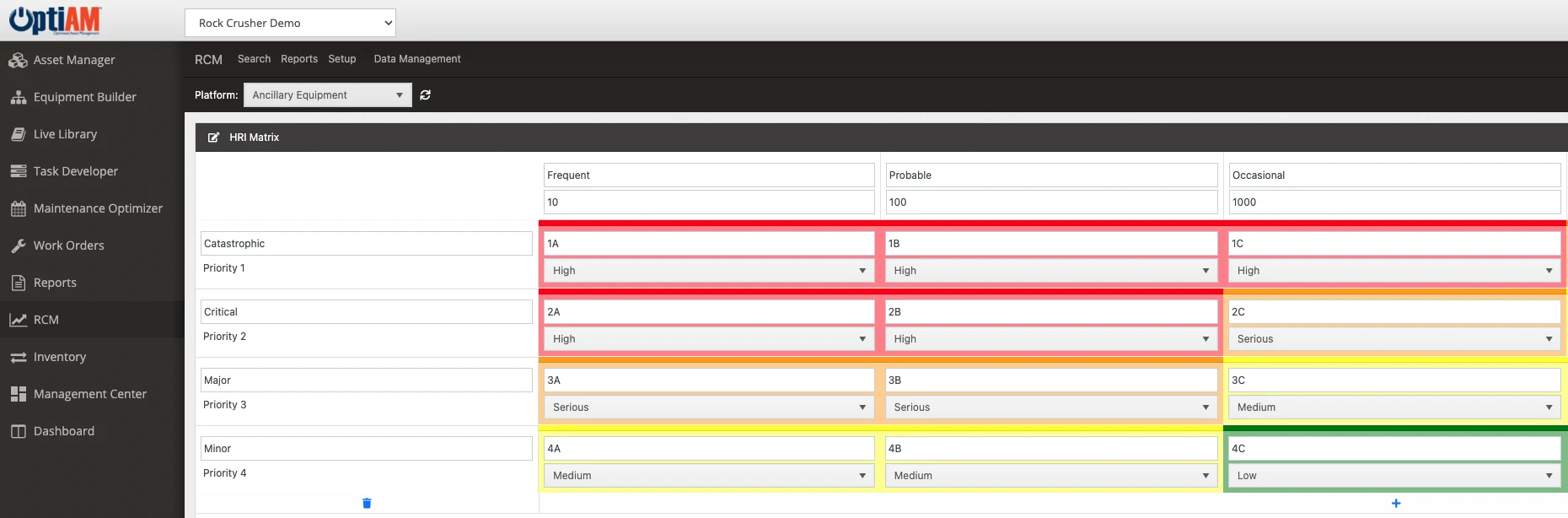
The OptiAM platform
Most PM Programs Were Copied, Not Analyzed
Plenty of maintenance plans started as the OEM manual plus whatever the last planner added. That is not a strategy. It is a habit.
Nobody knows why the task exists. A PM comes up every 90 days and nobody on the floor can say what failure it is supposed to prevent. So nobody feels safe dropping it, and nobody is sure it works.
Every failure gets the same answer. Some failures are worth preventing, some are cheaper to run to failure, and some can only be caught with an inspection. Without an analysis, everything gets a time-based overhaul.
The reasoning walks out the door. Even when a team does the analysis, it ends up in a spreadsheet or a binder. When the engineer who ran it leaves, the why leaves too.
Seven Questions Before Any Task Makes the Plan
RCM Analyzer follows the 7-step process defined in SAE JA1011, the standard that sets out what a real RCM analysis has to answer. For each asset, your team works through:
- What does the asset have to do, and to what standard?
- How can it fail to do that?
- What causes each failure?
- What happens when it fails?
- How much does each failure matter?
- What task, if any, will predict or prevent it?
- What do you do if no task is worth doing?
Start by building the hardware hierarchy, the same equipment breakdown Hardware Builder shares with the rest of OptiAM, then work down to failure modes. The answers become a maintenance plan you can explain line by line. You do not need a department of reliability engineers to do it. The software takes you through each question, and our team can help you run the first one.
Compare Strategies on Cost and Downtime
Run a full Failure Modes, Effects and Criticality Analysis (FMECA) on each asset, then put the options side by side. RCM Analyzer compares the cost and downtime of different failure management strategies, so the preferred option comes from the numbers, not from whoever argues loudest.
Once the decisions are made, package the tasks into an efficient maintenance plan your team can run. From there, Maintenance Optimizer schedules the PM program and Work Order Manager runs the work, all on the same platform.
Attach the source data behind every call, such as spreadsheets and graphics, right to the failure mode it supports.
Reuse the Work and Keep the Audit Trail
Most operations have dozens of assets that fail the same way. Cut, copy and paste large parts of an analysis within a project, or pull them in from other projects, so the tenth pump does not take as long as the first.
Revision management tracks every change to the analysis over time. When a PM task changes, you can see what changed and when, which gives your PM program an audit trail.
Built-in workflow and approvals keep the RCM project moving, and technical and project management reports show progress and the benefits you are realizing.
Proven on the Equipment You Run
RCM Analyzer has been used on vehicle and truck fleets, mining equipment, manufacturing equipment, facilities and data centers, and power generation. Mining companies, maintenance and repair shops, workboat operators and airlines use it, and so do organizations that hold reliability to the strictest standard there is, including the U.S. military.
At a Glance
What RCM Analyzer Does
Builds hardware hierarchies. Break equipment down into the systems and components the analysis runs against.
Runs full FMECA. Failure modes, effects and criticality for every item in the hierarchy.
Compares strategies. Weigh the cost and downtime of each failure management option before you commit.
Packages the maintenance plan. Turn analysis decisions into an efficient set of maintenance tasks.
Reuses analysis. Copy and paste across projects and use templates, so similar assets take a fraction of the time.
Tracks every revision. Revision management and project workflow give you an audit trail for every PM decision.
Want Help Getting Started? We Do RCM Too.
Andromeda Systems Incorporated, the team behind OptiAM, also offers RCM Services. We can run the analysis with you, lead your first sessions, or train your people to do it themselves. Our staff helped write the SAE JA1011 and JA1012 RCM standards and has completed hundreds of RCM projects on vehicle fleets, plant and mining equipment, facilities, data centers and hospitals.
RCM analysis. No staff to spare? Our analysts perform the analysis and work with your subject matter experts, so it captures what your team already knows.
Facilitation and mentoring. We help you stand up an internal RCM program, facilitate group analysis, and mentor your people until they can run it on their own.
Training. Regularly scheduled virtual classes and on-site courses, tailored to your industry or program.
RCM integration. We set up equipment hierarchies and failure coding in your maintenance system so the analysis runs on good data, and connect RCM to CBM+ and logistics systems.
Maintenance program development. We turn RCM results into a maintenance program you can actually run, including Maintenance Task Analysis for the tasks the analysis produces.
Your process, not ours. The RCM process we use is non-proprietary and SAE JA1011 compliant, so you own and control your analysis.
See an Analysis From Function to Maintenance Plan
Bring one critical asset. We will walk it through RCM Analyzer and show you how the failure modes, decisions and PM tasks come together.
Common Questions
Is RCM only for big operations or the military?
No. RCM started in aviation, but the thinking works on any equipment that costs you money when it fails, whether that is a haul truck, a compressor or a packaging line. Most teams start with a handful of critical assets instead of analyzing everything, and because RCM Analyzer is web-based, there is no big install or IT project to get going.
Do we need reliability engineers to use it?
No. RCM Analyzer walks your team through each question, and the people who know your equipment best, your techs and planners, are the ones who should be answering them. If you want a guide for the first analysis, our RCM team can lead it with you or train your people.
What is reliability-centered maintenance (RCM)?
RCM is an analytical process that works out the right preventive maintenance and other failure management strategies for a physical asset. Instead of starting from the calendar or the OEM manual, it starts from what the asset has to do, how it can fail and what each failure costs, then picks the task that is actually worth doing.
What is RCM software?
RCM software guides a team through the analysis and stores the results. In OptiAM that is RCM Analyzer, a web-based application that follows the SAE JA1011 process and keeps every failure mode, decision and revision in one place you can review later.
Is RCM Analyzer compliant with SAE JA1011?
Yes. RCM Analyzer supports an RCM analysis process compliant with SAE JA1011, the standard that defines what a process has to do to be called RCM. It uses the 7-step JA1011 process.
Does RCM Analyzer follow a recognized standard?
Yes. It follows the 7-step process in SAE JA1011, the standard that defines what counts as RCM, so your analysis holds up. It also supports the NAVAIR 00-25-403 process for teams that need it.
What is FMECA?
Failure Modes, Effects and Criticality Analysis. It identifies each way an item can fail, what happens when it does and how critical that failure is. RCM Analyzer runs a full FMECA as part of the analysis.
How does RCM Analyzer fit with the rest of OptiAM?
RCM Analyzer is one of the OptiAM modules and is fully integrated with the OptiAM enterprise asset management suite, so your analysis and your maintenance program sit on the same platform.
Most CMMS and EAM systems skip the reliability layer entirely. CMMS vs EAM explains where RCM fits.
In practice, Hardware Builder, Asset Manager and Inventory Manager work from the same equipment breakdown the analysis starts from, Maintenance Optimizer schedules the PM program, and Work Order Manager runs the work.
What kinds of assets can you analyze?
Truck and vehicle fleets, mining equipment, manufacturing lines, facilities and data centers, and power generation. If a failure costs you production, safety or money, it is a good candidate.
Can we reuse analysis across similar assets?
Yes. Cut, copy and paste large parts of an analysis within a project, or add them from other projects as templates, so similar assets do not start from zero.
Is RCM Analyzer cloud based?
Yes. It is a web-based SaaS application, so there is nothing to install and setup is quick. Your team works in a secure system it can reach over the internet.
Can your team do the analysis for us?
Yes. Through RCM Services, experienced ASI analysts can perform the analysis, facilitate it with your team or mentor your people until they can run it on their own.
Do you offer RCM training?
Yes. We run regularly scheduled virtual classes and on-site courses, and courses can be tailored to a specific industry or program.
See It in Your Own Operation
Failure modes on a haul truck look nothing like the ones on a chiller or a packaging line. To see how OptiAM fits your operation, start with your industry: fleets, manufacturing and plants, aggregates and mining, food and beverage, energy and utilities, facilities, government and public works, schools and higher education, landscaping or farming and agriculture.
See RCM Analyzer on Your Equipment
Tell us which assets matter most and where your PM program came from. We will show you what an RCM analysis would look like for them.
"*" indicates required fields